Black Marubozu Candlestick Pattern: Complete Trading Guide 📊
The Black Marubozu is the relentless wrecking ball of bearish patterns – no mercy, no bounce, just pure selling pressure from open to close! It’s like watching bears demolish everything in their path without taking a single break. 💥🐻

- Pattern Type: Single Candle
- Direction: Bearish (the steamroller of selling pressure)
- Alternative Names: Black Marubozu, Bearish Marubozu, Full Red Body
- Reliability Score: 0.65 (equally strong as its bullish twin)
- Win Rate: Variable (context dependent, but devastating when confirmed)
- Best For: Identifying powerful bearish momentum and distribution
📋 Pattern Classifications
- Pattern Type: Single Candle Pattern
- Market Direction: Strong Bearish Signal
- Pattern Category: Momentum/Reversal Pattern
- Pattern Family: Marubozu Family
- Reversal vs Continuation: Both (context dependent)
- Best Timeframes: All timeframes (stronger on daily+)
- Volume Dependency: Higher volume = stronger distribution
- Optimal Prior Trend: Any trend (reversal in uptrend, continuation in downtrend)
📊 What Does It Look Like?

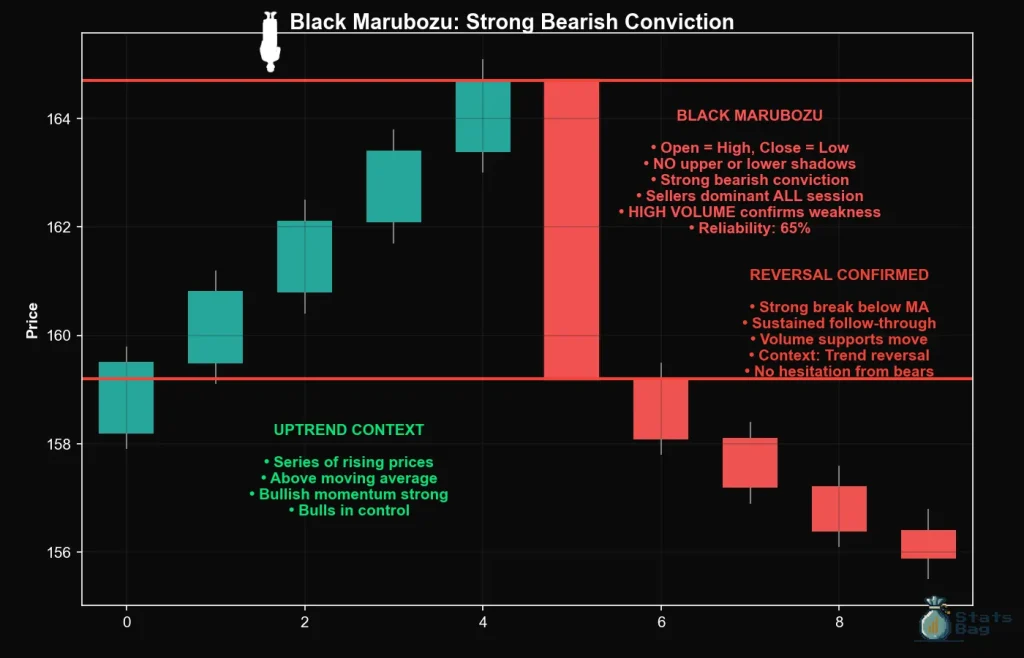
He has the same shape as his cousin, the White Marubozu, but the opposite direction. Picture a solid red brick with no gaps – that’s your Black Marubozu! It’s a full-body candle with no shadows, opening at the high and closing at the low. Pure, unfiltered selling pressure! 🧱❤️
Formation Criteria:
- Long bearish (red/black) body filling the entire trading range
- No upper shadow (or extremely minimal)
- No lower shadow (or extremely minimal)
- Open equals (or very close to) the high of the session
- Close equals (or very close to) the low of the session
Visual Key: If it looks like a solid red rectangle with no whiskers, you’ve found your Black Marubozu! 📦❌
🧠 Market Psychology
The Black Marubozu tells a story of complete bearish domination:
- Opening Bell: Bears immediately seize control with aggressive selling
- Throughout Session: Relentless selling pressure – no buyers step up
- No Bounces: Price never trades above the open (crushing weakness!)
- Closing Bell: Bears maintain pressure to the very end – no short covering
What This Really Means:
- Overwhelming bearish sentiment – bulls are nowhere to be found
- Heavy institutional selling or panic liquidation
- No buying interest at any price level
- Potential for continued downward momentum
- Market participants are extremely pessimistic about future prices
📈 Trading Strategy
⚡ Entry Strategy:
The Black Marubozu is your “abandon ship” bearish signal!
- Context Analysis: Reversal at resistance, continuation in downtrends
- Volume Confirmation: Higher volume validates the selling pressure
- Follow-Through: Look for continued weakness in subsequent sessions
🎯 Entry Rules:
- Breakdown Entry: Short on break below Marubozu low
- Bounce Entry: Short any minor bounce to Marubozu body
- Immediate Entry: In strong downtrends, short at close of Marubozu
- Gap Follow: If gaps down next day, short the gap or breakdown
💰 Profit Targets:
- Measured Move: Project Marubozu length from its low
- Support Levels: Next significant support zone
- Trend Following: Use trailing stops for maximum profits
📚 Key Takeaways
- 💥 Pure bearish power – no hesitation from sellers
- 📍 Context determines strategy – reversal vs continuation
- 📊 Volume validates weakness – higher volume = stronger signal
- 🐻 Momentum indicator – often leads to further declines
- ⚡ High reliability – 0.65 score shows consistent performance
Bottom Line: The Black Marubozu is like watching a perfect storm of bearish sentiment – when everything aligns for explosive downward momentum! 💥📉
📒Full Candlestick Pattern Guide
- 🕐 Learn Candlestick Patterns Fast – Spot Profitable Signals in 5 Minutes
- ✅ Candlestick Patterns That Work – Highest Success Rate Signals
- 🏯 Japanese Candlestick Patterns: History and Psychology
- 🛠️ Candlestick Patterns for Beginners – Your Complete Starter Guide
- 🤿 How to Read Candlestick Patterns – Components Deep Dive
Disclaimer: This is educational content only, based on common investment and trading industry knowledge. This is not financial advice, and we are not financial advisors. Always speak with a professional financial advisor before investing. Use of this content is at your own risk.